




Essay copied below appears in the journal TransAtlantica: American Studies Journal, 1/2009: Homage to Michel Fabre, as part of a forum on "Un Patchwork de Cultures"
Link to version in journal issue and forum on "Un Patchwork de Cultures"
http://transatlantica.revues.org/4321
Binding Nations through Art Quilts and a Visit to the U.S. Embassy in Paris as a Cultural Envoy
Riché Richardson
In the spring of 2008 when Géraldine Chouard, who was helping to coordinate the landmark exhibition in France entitled “Un Patchwork de Cultures,” mentioned the U.S. Embassy in Paris’s interest in inviting me to the city to share some of my quilts as a part of this exhibition and to be a “Cultural Envoy,” I was honored and excited by the possibility. The opportunity to return to Paris under the auspices of the U.S. Embassy, which officially materialized through a grant from the U.S. Department of State as part of its Speaker Series, allowed me to see Paris from a different and wholly new perspective from the one I had on my first trip to the city in 2007. I experienced a lot of support at the U.S. Embassy and deeply appreciate all that the Cultural Affairs Office did to make this visit so memorable and successful. I benefited from spending time throughout the week dialoging with Sophie Nadeau, Lora Berg, Jennifer Bullock, and Randiane Peccoud, among others, and they helped to enrich my perspective on global affairs. For instance, I was inspired by Lora Berg’s commitment to promoting the use of diverse languages within institutional settings on websites to help encourage international exchanges. These dialogues were especially enriching against the backdrop of the upcoming presidential inauguration in the United States.
2On this recent visit, I had accommodations at the Hotel du Pantheon in view of Mairie du 5e (fifth district), the exhibition site, and the Pantheon, which are a block up from the Luxembourg Gardens. I usually began my days with breakfast at one of the neighborhood cafés before reporting to the Embassy. All of the events in which I participated, including talks with three groups of high school students and three groups of college students, several gallery talks and film screenings, as well as my talk, film screening and reception at the Ambassador’s Residence (during the tenure of Craig Stapleton), along with a workshop on diversity at the U.S. Embassy, were deeply enriching and inspiring. These experiences have strongly impacted my missions in teaching and art and reinforced my commitments to making a difference as a citizen. They have expanded my knowledge of French culture, along with its history, and a range of social and political concerns, from contexts such as the academy to the banlieue.
3I was deeply honored to have had five of my art quilts, including two from my Paris series (Josephine Baker, Simone de Beauvoir), two from my family series, and one from my political series (Barack Obama), featured at the Mairie du 5e among the work of such talented quilters in the U.S. That toile fabrics are incorporated into some of these extraordinary works, which highlight figures from George Washington to the Marquis de Lafayette, helps to embody the intercontinental connections to which the exhibition itself stands as a tribute. I was particularly moved by works such as the “Bad News Quilt,” which incorporates paper news articles about the tragedy of Hurricane Katrina, along with others such as “Walk the Walk Fleur de Lys,” which is a reminder of the rich heritage of Louisiana. This exhibition is quite remarkable in its conception and vision, and is a valuable teaching tool for American and French classrooms alike. I used an image of “Let Freedom Ring,” a quilt with blocks featuring Phillis Wheatley and the Liberty Bell, in the lesson on Phillis Wheatley this semester here at Cornell University where I am now a professor, alongside a copy of the frontispiece from her 1773 book of poetry.
4Both my quilts of Josephine Baker and Simone de Beauvoir were completed in time to mark their centennials in 2006 and 2008, respectively. My quilt of Josephine Baker presents a larger than life image of her more focused on performance and singing than the body itself, reminding us of the beauty and dignity of the body. The quilt of Simone de Beauvoir celebrates her intellectual legacy and the thought, energy, passion and commitment of her intellectual journey. Both quilts present their subjects in the prime of their lives to reflect their deep and lasting legacies, and their place in our collective history and memories. The baby quilt featuring my mother and uncle is from my family series and reminds us of the beauty and dignity that existed among blacks in the U.S. South even during the pre-civil rights era. As I explained to audiences on several occasions, the word “Always” in the background of my quilt honoring Barack Obama’s inauguration reflects my view of him as a leader and respect for him as a person from whom I hope to learn for years to come, and as the kind of man whom I also want any children I ever have to know about. On this visit, I was also very much honoring in my own way the 2008 centenary of the African American and Southern writer Richard Wright and remembering his family and all of the celebrations of his life and legacy in Paris the year before.
5This was a very busy trip with long, busy and stimulating days that usually began at the U.S Embassy, sometimes with the required trip through security, or just to meet up with the driver who would be responsible for the day’s transportation to different events. Indeed, this trip gave me a more panoramic and complex view of the landscape of Paris than I’d had before, and I was especially inspired and motivated by the several opportunities that I had to dialogue with students at institutions in the banlieues. These encounters left me with a deep appreciation for the bright students whom I encountered, and a longing to become fluent in French so that I would be able to return to the city at some point for even closer dialogues with Paris youth. It left me with a desire to work to help the effort to bring about change for those who feel marginalized and excluded from French society.
6The first event was a visit to Collège Martin Luther King in Villiers-le-Bel in Eastern Paris. There, I gave a talk to high school students entitled “Art in Education and My Education as an Artist.” It highlighted the role of art in helping to sustain the health and well being of a democracy, the difference that art literacy can make in helping to set foundations for a lifetime of learning, and the importance of students making a commitment to examine local art resources in places like the Louvre. I also discussed the utility of art in my own teaching, and art as a gateway to the humanities. In the rich q&a that followed, students showed excitement about Barack Obama and asked a range of questions. I was impressed that an exhibition of life-size military figures made by students, in the form of cardboard cutouts, was on display in the school’s lobby entitled “14-18/2008: les colonies dans la Grande Guerre,” which the principal Christiane Tyburn gave me a tour of after the talk, along with a gift of the accompanying catalog. The high school also plans to share with me a picture of a mural that will soon be painted on the school building. The translation was provided by Jennifer Bullock and Mrs. Tyburn. As the day ended, I got a reminder of the simple pleasures and adventures in life through the fact that some boys stuck around after school just so they could see us drive off in the Embassy car. This was also a reminder of how removed some citizens may feel from the center of culture in Paris.
7At the U.S. Embassy, where on entering I saw pictures of President George W. Bush, Condoleeza Rice, and Dick Cheney, I gave a talk that addressed the public response to Hurricane Katrina in 2005, and the impact of the U.S. South on race and gender politics in the 2008 presidential election. The talk led to a broader dialogue with the newly formed diversity group at the U.S. Embassy, which is concerned about addressing issues of diversity for over 1000 employees. The dialogue, which was held in one of the dining rooms, set off a revealing and productive debate among the diversity group, whose members differed widely in perspectives. This event was coordinated by the Public Affairs Officer at the U.S. Embassy, Randiane Peccoud.
8I was delighted to offer a brief talk at the exhibition site with a group of girls and one boy from Théodore Monard Vocational High School from Noisy-le-Sec, “On the Legacy of Rosa Parks, St. Jude Educational Institute and the Youth Mission in Montgomery.” I discussed St. Jude Educational Institute of the “City of St. Jude” in Montgomery, which I attended, the campus’s role as a camping place in the Selma-to-Montgomery March in 1965, and its hospital as a haven for blacks in Montgomery during the era of segregation, and as the backbone for expanding the black Catholic community in Montgomery. Their teachers expressed appreciation that several students who do not ordinarily participate or talk in class were so open in the dialogue with me. Géraldine Chouard provided the translation.
9At the exhibition opening reception in Paris with local and Embassy officials that over 200 guests attended, I made remarks on my quilts featured in the exhibition with the translation provided by Géraldine Chouard, who gave a tour of the exhibition and made extensive remarks on my quilts and the 25 quilts featured in the travel exhibition. I particularly valued the stories that some of the guests at this event took me aside to tell in relation to my Josephine Baker quilt, such as that of a couple who attended the last concert of Josephine Baker in 1975, and a woman among the French quilters who told of a customer whose mother had made costumes for Josephine Baker, and who once attended a costume fitting for her years ago during her childhood, feeling that Baker’s was “the most beautiful body she had ever seen.” For me, another highlight of this reception was meeting Ernest Doo Koo, an artist from the Ivory Coast who had visited and admired the exhibition the day before, and returned to the reception for an introduction.
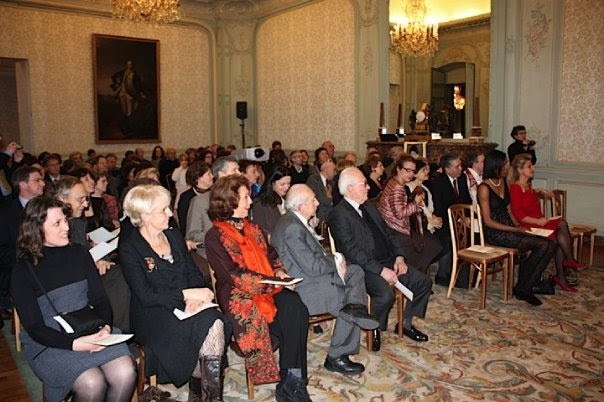
10The focal point of my trip was a visit to the Ambassador’s Residence on January 14, 2009, where I gave a brief talk entitled “Reflections on Montgomery’s Modernism, the Civil Rights Movement and the Paths to a New Southern Art in the U.S.,” and three of my quilts were shown (Josephine Baker, Simone de Beauvoir, and “JoAnn and Junior Man”). Géraldine Chouard and Anne Crémieux’s short film on my art, “A Portrait of the Artist,” was presented by them and screened after cocktails. I understand that this was the last official public event sponsored during Ambassador Craig Stapleton’s term prior to his family’s return to the U.S. My talk began with an emphasis on my own belief that “for its health and livelihood, a democratic society should help to actualize and develop the artistic gifts of its citizens, whether that means supporting community and grassroots initiatives or building institutions that can help to catalyze individual and collective art projects,” noted the centrality of art to how I have lived the truth in the American dream, and acknowledged the connections of my own art project to a background in the U.S. South.
11I mainly drew on my own grandmother’s experience as a teen in the National Youth Administration inaugurated by Franklin Delano Roosevelt, and her later experiences migrating to Pensacola, Florida with my grandfather and working on a job in the Navy Yard, to show how opening up such opportunities as the NYA to black youth in Montgomery who had been shut out of the system by segregation made a difference in her life and prepared her to help support the project of American democracy later on. These points were important to me to emphasize, for instance, in thinking about a similar sense of exclusion from French citizenship and opportunities that many minority youth feel in the suburbs of Paris, frustrations that were highlighted on a global scale during the unrest in 2005. Anne Crémieux provided a simultaneous translation during my talk. This event was also significant in that it marked the first time that all involved in the film attended a screening of it together, including the filmmakers Géraldine Chouard and Anne Crémieux, Patricia A. Turner, who provided scholarly commentary in the film, and Diane de Obaldia, a former Chanel model and owner of Le Rouvray, a quilting store in Paris. I enjoyed seeing more of the beauty of the Ambassador’s Residence on the brief tour that those in our core group were given shortly after arriving, along with a book on the residence. Over 120 guests attended this event.
12Anne also coordinated one of the events for me the following day, a visit to Université Paris 10, Nanterre where I gave a brief talk on quilt work, appliqué, and the process of making the film prior to a film screening and q&a with her students in African American history and a U.S. politics research group. Here, we also discussed the role of art in teaching and issues such as balancing artistic and academic life. This session was also attended by Patricia A. Turner, who discusses my quilt work in her book Crafted Lives: Stories and Studies of African American Quilters. Later that evening, I met with the Société d’Etudes Nord-Américaines (SENA) for a dialogue based on my book, Black Masculinity and the U.S. South: From Uncle Tom to Gangsta and a talk entitled “Black Masculinity and the U.S. South: From the Myth of Uncle Tom and the ‘Bad Negro’ to the Jena Six.” My talk situated my project in relation to contemporary issues such as the Jena Six and the continuing phenomenon of nationalizing and globalizing Southern ideologies as well as the region’s major movements. It was wonderful that a dialogue continued over dinner with a range of French scholars who work on the United States, including the phenomenal Catherine Pouzoulet. We mainly discussed academic labor issues in France.
13The last full day of my trip began with a meeting with Pont-Blanc Raconte and France Patchwork Paris where I offered remarks on quilts to a group of women present for a workshop on quilt-making.
14Afterwards, Cultural Affairs Officer Lora Berg worked around our tight schedule and arranged for me to attend the gallery talk by Cedric Smith for the opening of his exhibition at a new gallery focusing on African American artists in the city, for she wanted me to meet him and see his work. Later that afternoon at Suger High School in Saint-Denis, I discussed the history of Rosa Parks and my encounter with civil rights history at St. Jude Educational Institute. When I emphasized the utility of placing Barack Obama in the larger continuum of black American leadership, spanning from Dr. Martin Luther King, Jr. and back to figures such as Frederick Douglass, students—in this case black males—asked who Frederick Douglass was; they had never heard of him. This was a reminder that we cannot take for granted that students, including those of African and Caribbean descent, will have a sense of history in the United States. The course instructor, Aurélie Gigot, made extensive notes on the board as I lectured and the session was rich and engaging. I found the session to be so absorbing and my passions as a teacher so intensified that I lost all sense of time as one question and one topic led to another, but I finally had to end it because the Embassy driver was waiting to take me on to Bondy. This encounter has inspired me to do a black history art quilt series and has also made me all the more determined to do more teaching at the grassroots level.
15My final event was a trip to Bondy to the office of the Bondy Blog. I was interviewed on site in juxtaposition with the Obama quilt and asked numerous questions, including whether Obama would be able to live up to his campaign promises, whether he would be seriously committed to issues of foreign policy, how Americans were responding to the election, whether I thought Obama’s popularity mainly had to do with disappointment with the administration of President George W. Bush, and whether Obama and Hillary Clinton would be able to put aside their old rivalries and effectively work together. My responses were translated by Randiane Peccoud from the U.S. Embassy. Later, nineteen bloggers from Bondy arrived to screen “A Portrait of the Artist” and asked me questions of their own for several hours, including whether I thought an Obama was possible in France given the nation’s specific issues related to race and identity. My comments were translated by Randiane Peccoud and Sophie Nadeau from the Cultural Affairs Office at the U.S. Embassy, who coordinated the event.
16I had so much savored my first trip to Paris in 2007, including the experience of working with Géraldine and Anne Cremieux, and the adventures we’d had in the city in places such as Montmartre, the Simone de Beauvoir bridge, and the St. Germain-des-Prés area as they made a short film to accompany my upcoming art quilt exhibition at Montgomery’s Rosa Parks Museum Gallery and Library entitled “A Portrait of the Artist.” I could not have ever imagined that some works from it would intersect with a project as phenomenal as “Un Patchwork de Cultures,” and, for a few days, become a part of such an important and rich national exhibition of quilts. From beginning to end, my two trips have fulfilled so many of the dreams I’d long had about Paris, dreams that had kept me motivated and inspired as I lived in California and worked as a university professor and also made art.


 Posts
Posts


