By Riché Richardson
For this third blog post on the Trayvon Martin case, to follow up my two from last spring, I want to focus more on black female subjectivity through his friend Rachel Jeantal, to whom he was speaking on the phone before George Zimmerman took his life. Please be forewarned that this is a longer and more personal post than usual and is really more of an essay. By the end, I think readers will understand why. Like a lot of others, I have been concerned about the propaganda that has unfolded about her since her testimony at the Zimmerman trial, propaganda related to her body, voice, demeanor, language and nationalities. I had no problems at all following her verbal-and non-verbal-communication styles, and grasped her phrases like “coulda hear” that the defense seemed intent on distorting and misreading. I loved her interjections of statements such as “you can go,” and “are you listening,” which made me feel all the more that she is entirely sincere. Moreover, the questions raised related to her literacy obscure the chronic neglect in the educational system for black youth like her. The condescending and dismissive readings of her have been very unfair, especially when I think of how problematic and ridiculous it is to make judgments about whose testimonial voices have validity and who is “fit” to represent blackness. Rachel Jeantal, too, is American.
Why is the tendency to ignore the beauty, dignity and voice that she possesses, and to insistently script her in relation to the grotesque instead? Is making fun and joking the only way that some people can deal with the diverse array of black female bodies that might conceivably become legible in the media and attempt to claim voice? When Lolo Jones made fun of Ms. Jeantal and tried to construe her as a caricature by invoking Medea, the moment seemed to recast the interplay between Toni Morrison's characters Maureen Peal and Pecola Breedlove in The Bluest Eye, in which Maureen shouts at Pecola, “I am cute!” Ms. Jones seemed to have totally forgotten that article in the NYT last year where it seemed that her public image was being mocked, devalued and under assault, in a way that I found to be offensive and that was also deeply hurtful to see, especially as another black woman. That is the kind of thing that can happen in our hyper-visible media culture, no matter how one sounds or looks. When analyzing the politics surrounding Ms. Jeantal, a character like Sapphire’s Precious, who has been powerfully rendered on screen by the director Lee Daniels, may come to mind when thinking of the issues of literacy, the scrutiny before state power and certain body politics that have emerged, but even that narrative would fail to account for how utterly captivating, mesmerizing and engaging she was as a platonic friend to Trayvon, to the point that he called her and called her; the siren metaphor, in the sense embodied by Angelina Jolie, can only capture Rachel's beauty, attraction, power and distinctly alpha femininity in that sense. And once she offered her testimony, many people were utterly riveted, glued to their television screens, and as captivated by her as Trayvon was!
I feel that it is crucial not to lose sight of the tragedy that this young female high school student has endured, and the courage that she has shown in the face of it. I have also heard a lot of speculations about “the community” that Ms. Jeantal comes from and queries related to “who she is.” Some people are acting as if she comes from an entirely different species, and as if only the most standard and formal uses of English language are acceptable or admissible in public forums, which is ridiculous in a nation as diverse as the U.S. In the end, none of these factors should impact the public’s ability to relate to her testimony. I am astonished by raced and gendered perceptions suggesting that the jury will not like her and would be incapable of hearing and relating to her testimony. I do understand why an almost all-white and female jury could very well end up feeling that way. I can only speak for myself. As an adult black woman who was educated in private school, who grew up in federated clubs and organizations, who was a student leader, who came out as a debutante, who is a Delta, and who earned a Ph.D, I certainly do not feel that any differences are dramatic in a way that would make her too different and other for me to grapple with or to even talk to and comprehend.
As I continue this dialogue, I want to describe an experience that has helped me to understand and identify some with Rachel’s. I had a call before a friend went to heaven, just as Ms. Jeantal did. So I knew where she was coming from in describing all the complex feelings that she had in the aftermath of losing Trayvon, and recognize the sadness, pain and trauma that linger in her. Rachel Jeantal has been invisible, misunderstood and dismissed by some in the course of her testimony about Trayvon. The pain I was experiencing after losing a friend was entirely invisible, unrecognized, unseen and ignored in the context of the university.
On April 11, 2004, Easter Sunday night, a girl friend I had first seen when we were ten and our respective Girl Scout troops shared Trinity Lutheran School as a meeting place, with whom I ate lunch at the same table among our other girl friends every week day of high school for four years, and who had remained in Sacramento where she had been stationed in the military, called to wish me Happy Easter late that evening, around a quarter to nine. It was like her to reach out on holidays. Weeks earlier, I learned that she had even come downtown to visit me on Valentine’s Day back in February, but I had been away in Mississippi at a conference at the time. So the last time I saw her was one August evening in 2003. It was a Saturday evening on which I needed to stay in to do work when she called me about getting together and going to this new popular restaurant/lounge in the tourist area of Old Sacramento, and so she said she’d just come by to chat for a bit. She brought me a set of scented candles as a gift. I wasn’t dressed that evening to go anywhere, and I wasn’t in a mood to put on anything or even go anywhere, but she looked great all dressed up and had also gotten her hair done earlier that day. At one point during her visit, we caught the fireworks from the Sacramento River standing out on the balcony of my apartment, which was three blocks from the capitol. At one point, she asked me if I had a camera. When I said I did, she asked if I’d take her picture in this amazing animal print outfit she was wearing, so I did. All of the cheerleader in her came out in the dynamic pose she struck, with her arms stretched out as far as possible on either side, and a beautiful smile.
With busy schedules, we didn’t always talk very often, and sometimes weeks or months went by between conversations. I had stopped calling and allowed her to do the calling once she moved in with one of her church members months earlier, because I felt uncomfortable and somewhat awkward calling and asking to speak to her at someone else’s home. She may have also called me that Easter Sunday evening because she had seen (i.e. via caller ID) that I’d tried to get in touch with her that Friday afternoon after attending an exciting Stations of the Cross ceremony at the church at St. Francis Terrace in Sacramento, but hadn’t reached her. When I had called that afternoon, someone at the woman’s home where she was staying hung up in my face, which had seemed peculiar. I thought I had the right number written down, but suspected that it must have been wrong. The first thing I did when she called was to ask her if I indeed had the right number, and to read it to her, and she verified it as correct. Then, I asked her if she was still staying there alone, and she said, “No, the lady of the house is back, and her grandson is here.” She mentioned that they’d come from the East Coast two days earlier. I was actually relieved when she said she was no longer there alone, for she’d “house sat” for months for one of her church members far out in a suburb of Sacramento called Antelope, which I’d never been to. She had once invited me to attend a picnic out there for the Fourth of July, but I told her that it wasn’t right for her to take a friend to someone else’s home, and that I’d be all right spending it alone. I did high rise living downtown in Sacramento, and worked in Davis, so life for me basically revolved around commuting by bus back and forth to my job, and doing things in downtown and midtown, or antiquing and going to the mall and fabric stores now and then in Woodland. I’d seen the place on base she lived in when I moved from Davis to Sacramento and we reconnected in person. I had never met the woman she lived with, in spite of my open invitation to my friend to bring her downtown to my apartment sometime for a visit and for lunch if she liked. I wondered why this woman did not seem to be the least bit interested at all in meeting my friend’s friend, especially one who was a university professor and lived downtown. I was sure that my friend had told her all about me and mentioned my invitation. I even mentioned my puzzlement and disbelief over it to my mother when she visited me in California the week before (“I wonder why the woman she lives with is not interested in meeting me?” "That’s so odd."). The woman had lost a daughter our age, 32, the year before, and it was sad when my friend described what happened. At the same time, I had wondered to myself if she was emotionally ready to have another young woman around and so close to that age like my friend, and had inwardly wished that my friend lived somewhere else.
After my friend left the military, I saw the second of her two apartments, which she decorated with a beautiful pink satin bedding ensemble and a leopard sofa cover. Her large CD collection was also nice. She decided to leave the first one because of noisy neighbors who lived above her. It did not help that she was in the parking lot walking toward her car one day and a white woman at her complex just mumbled something and walked up to it and spat on it, which is infuriating whenever I think of it even now. She had left California for a while, but loved living there, and when she returned a few months later, she decided to live at the home of one of her church members and to take her time in settling down again. In that sense, she seemed to be doing everything right.
I was playing my Blind Boys of Alabama CD that Easter Sunday night when she called. We talked about a lot of things. I told her about the mass at St. Francis and the giant wooden cross passed throughout the audience. We talked a while about the recent film The Passion of the Christ, which both of us had seen. I told her that I was going on a trip to Philadelphia soon. “Oh, Philadelphia,” she said. I mentioned that I was preparing for a lecture on Frederick Douglass in my African American literature graduate seminar that Tuesday. She wanted to revisit a point that she said had come up in one of our prior conversations and overviewed aspects of the history of the Roman Empire and Constantine, which reflected her very profound knowledge about church history. She mentioned that one of her dreams was to go on a cruise, and that she’d treat me if I came as well, but I insisted on paying my own way if we went. At one point, I heard something in the background, like a voice, that got her attention; she asked me to hold on and stepped away to check on it, and then returned, but said nothing about what it was. Something stopped me from mentioning anything about the guy I was dating at the time, because for some reason, chatty “girl talk” just seemed out of place that evening, though I’d told her about him several months earlier, including that I was “falling in love,” which she enjoyed hearing after many failures to ever get me to talk about subjects like the kind of wedding I’d like someday. In a phone conversation one Friday evening a few years earlier, when we were in our late twenties, she had once described her fantasy to me of a wedding ceremony with the NBA player Chris Webber, which in retrospect, I am deeply thankful that she shared. She had so many dreams, including marriage and children, and wanted those things like a lot of young women. I had had my crush on him in the early 1990s, but she is, I’m sure, one of the sincerest and most devoted fans that he has ever had. Indeed, she once sent me a beautiful photo of herself posing with Chris Webber at the annual Dinner with the Kings, which she tried to talk me into attending, because she felt strongly that with my tall height, “You could really attract a player!” It was flattering and amusing to have a friend who believed in me that much, and who was always so supportive of all that I was doing in general. For example, when our spiritual mentor (to whom she first introduced me in 1993) asked me where I’d pledged Delta, she proudly recited all the information before I could even say anything. She is one of the best friends that I have ever had, and I cherish that she had even come to regard me as her “best friend.”
Once when we talked in the fall of 2003, she was also reading different books and excitedly told me about various titles she’d been reading, such as Michael Eric Dyson’s most recent book. My dream for her was to see her attend divinity school. She was one of my favorite people with whom to dialogue about spiritual matters. The most serious debate we ever had was one about whether a person could lose their salvation. As one of the best Christians I have ever known in my life, she was adamant that it was possible to be blotted out of the Lamb’s Book of Life. I argued that if that was the case, then Jesus died in vain. That outlook didn’t make sense to me. A few days later, I was surprised to get a letter in the mail from her outlining her perspective, a letter indicating that while she had taken mine into consideration, she could not agree with my argument. I mailed her a copy of Rev. Charles Stanley’s book Eternal Security: Can You Be Sure? When she finished it, she called me to tell me that she understood how sure and secure her Christian salvation is. She had first talked to me about her faith in tenth grade, a time when I had flipped over her belief that women could go to hell for even wearing pants. This moment in her walk, in her acceptance that there is absolutely no way that one can lose the gift of eternal life once one’s faith is professed, was also powerful to witness. And she had professed her faith and become a committed evangelist of it and was witnessing to her peers before most people in our generation were thinking seriously about those matters. She is one of the best and most devoted Christians I have ever met in my life.
I am not sure how long we talked that Easter night, but the Blind Boys CD played twice before we hung up. The next morning, I thought about what she’d said about the cruise, and all the work I needed to do, but decided that I’d make time anyway and go along with her since that was her dream and she seemed to be so excited about it. That Monday evening, I went see my tax preparer. I gave my lecture on Douglass that Tuesday as planned. I remember crossing Capitol Avenue that evening and thinking of things that I still needed to tell my friend, and things I’d forgotten to mention that Sunday. I felt comfortable with my work, and with my life, even happy and thankful for everything, including good friends.
When I got to my apartment, I had a message from our mutual spiritual mentor, who told me to call her. She asked me if I was sitting down, and then told me that my friend had been murdered. I was in disbelief, and told her that was not possible, that I’d talked to her two days ago, at Easter. She described what happened. I looked for any information I could find in the news and saw the brief story about a young woman being stabbed multiple times while taking a bath, and that a suspect was in custody. It was unthinkable and unbelievable.
There didn’t even seem to be a way to classify accurately what had happened. Domestic violence was not an adequate descriptor, in the sense that her life was taken by someone who was mentally ill, whom she did not know and had met just two days earlier. This man in his early twenties was a stranger to her. She'd had no idea that she was in the midst of a person who was unsafe to be around.
I attended her service and spoke during the reflections. The service was beautiful. She would have been deeply touched by how powerfully her home church community celebrated her life, and by the sermon. My remarks described her as a “Saint.” Just as girl friends seemed to, our spiritual mentor’s son and I seemed to have recognized the trace of what she must have experienced in her final moments, and standing there after the service, where we waited as the processional drove off to her burial, he said he wished he could “beat him up.” It struck me as a distinct and specific coping strategy for a guy, for it hit me that doing so had never once occurred to me as a woman over those days. That's not to say I didn't imagine it; I wished I'd been there instead. People tend to perceive me as a nice and sweet person, but she was definitely far sweeter, and didn’t seem to ever get angry at all, so I just wished it had been me instead of her he had come up on like that in that bathroom, like I wished I’d been the one in that parking lot that day. She just quietly wiped it off, but I might not have been able to turn the other cheek as quickly as she did in this situation, and may have even threatened to call the police on the woman, pointed out to her that she’d just left her DNA on my car and said that it could be used as evidence against her if I decided to press charges. When I heard about it, I definitely wished that woman had come up on the type who would have dealt with what she did in that “I KNOW you did NOT just SPIT on MY car!” way.
It was unbelievable that by the time I gave that Douglass lecture, my friend was gone. I was utterly traumatized. It hurt to pass the bench I’d been sitting on after I’d gotten my taxes prepared. To have the conversations play back in my mind, like my Monday morning thoughts about that cruise, or my thoughts as I crossed Capitol Avenue that Tuesday evening without a clue in the world about what had gone on. It pained me to pass the St. Francis apartment building I’d told her about and urged her to consider moving into, because it always made me wonder what could have been. The pain was there whenever I passed by any of the restaurants we’d ever gone to. A tub of water I once dreamed of also registered the trauma. It hurt to even hear Antelope mentioned on the news in traffic reports. The trauma was just that deep. I had no sense of where the area was, and how truly far out it was, until two years later, on a trip to a retreat with the university, when we passed through that area on the way out of the city. He had never been anything but kind to me, in spaces like the lobby and elevator, but I must admit that I felt relieved when I spotted some golf clubs over on the balcony of the African American guy in the apartment next door to me, in the weeks after I’d overheard him and his wife arguing one night. I was left almost shell-shocked, and there were certain words I could not stand to hear, as well as subjects I could not bear talking and hearing about. All I could say to myself was “I don’t know, I just don’t know.” I wondered for a whole summer “how could this have happened?”
Early in the new year, a male friend called me and I seemed so giddy that he asked, “What’s happened to you? Why are you so happy? Did you get a call from Harvard or something? I told him “No, it’s better than that.” I had been so lighthearted that spring and imagined that I had finally met “my Destiny.” The experience of losing my friend was as jarring and as shocking as standing at the end of the wedding aisle and having a shot fired right down the middle. To receive yet another sweet note, but to say that the plans are off for now, and to put life on hold. To not even be sure I wanted to live any more, to wish I, too, could die, and to at the same time feel absolutely terrified because of what had happened to my friend. A new novel by Thulani Davis describing a similar experience of losing a friend was a great comfort to me, as was the minister’s sermon “Watchman, What of the Night?” at church that summer.
Life for me was never the same again, and never will be again. That experience made it utterly impossible for me to ever trust life again. I totally lost my ability to trust most people, especially older black women I didn't know like the woman she had trusted and lived with, who was said to have run next door to call a relative (not even the police!) and left my friend in the house at the mercy of her mentally ill grandson. Every conference that I attended and every talk that I gave was a miracle during that time. Being alone in strange cities and even something as simple as stepping out into the hallway at a hotel alone made me uncomfortable. I never had to. My mother and college roommate from freshman year met me at conferences in Mississippi and Atlanta, respectively, and slept in the bed with me. The guy I was seeing took off his job to meet me in several cities for others that year. When I went down, stood and spoke with charisma, and in my typical style without notes and introduced a panel on civil rights photography at a major conference in 2004, only my mom and a top scholar/ mentor in the audience I’d told about what happened to my friend truly knew and understood what it took to do that in front of a huge audience and the intense pain I was still feeling as I spoke. Another close girl friend also told me about the loss of one of her former professors at the hands of a student she had mentored, who was infatuated with her, became enraged when he saw her at a Valentine’s party on campus with another man, stalked her home and decapitated her. Then had gone out and killed himself. That tragic story was also sobering and terrifying and underscored the lack of safety, even in university settings. My friend said that one does not know who students are all the time either, or what some could be capable of, and made me promise her that I would not ever have them over again to parties at my home, which she knew I sometimes hosted at the end of my graduate seminar. And I didn’t, not for another five years.
I have kept my filters tight and my circles very small since then, and am okay with that. Even now, I tend not to have social interactions with people I don’t know. It has been an uphill struggle to feel safe with black women who were not already friends, or who are not family, and for months, it took a long time for me to get beyond the image of a woman running out to save herself as my friend was brutally murdered by a grandson she brought there, and who had not even called the police, but called a relative. The police drove up, and the paper said that he was just standing out in the front yard holding a bloody knife. From the day I learned that, I have kept my distance, been entirely my own woman, and accepted that not every woman in this world can be my sister or my friend. I have definitely come a long way over these years, in terms of the healing process, in the sense of being able to be at least a bit more open now in ways that the thirty-three-year-old me was absolutely incapable of being after this tragedy happened, and that would have been absolutely out of the question for me. I insisted on having Thanksgiving dinner alone in 2004.
Only faith and prayers helped me through this very difficult period. God got me through it and also broke my bonds with certain people. You really learn who your friends are. I mean, if a person can hear that someone suffered a tragedy like this, and then not give them as much as a phone call to see how they are doing, then they are not much of a friend; there’s really not much to say for them anyway. “Great Is They Faithfulness” was the song He wrote on my heart. Indeed. “All I have needed thy hand hath provided.”
For several months, I got a few cards in the mail from people I didn’t know, and I appreciated how they reached out. I presumed they came from some of the members of my friend's church. One day when I went to my office, I found a message on the answering machine from one of our mutual old friends, and we talked. I paid no bills between April and June, but finally, realized that I’d have to pull it together or end up with my utilities turned off. It helped, too, and I was pulled back to reality, when a friend and reporter had left a message on my phone one day I got back from campus telling me that “It is time for us to talk about this.” She wanted to do a news feature story on my friend, and so I put her in touch with a member of my friend’s family and our spiritual mentor. (I shared some of my reflections on her in the foreword to the remarkable book by our mutual spiritual mentor entitled Come Inside: Discovering Your Purpose, which is available on Amazon.com). In general, her story needs to be told and celebrated by the people who knew her and have a sense of what a special and remarkable person she was. Cheerleader. Class valedictorian. College graduate. Military career. Her beautiful laugh. Her laughter. Her beauty. Her profound and devoted Christian faith. She wrote a wonderful essay for an anthology that a friend and I were co-editing in the early 1990s. I still have a copy of it, and will be sure to post it at some point, which will be especially inspiring, I think, to all the people who knew her. I also posted that great picture on Facebook one day, because I know she would have wanted her old friends to see it.
It hurt so deeply that the wonderful and well-meaning news story about my friend by this outstanding reporter, that included interviews with some of her family and her mentor, which sounded lovely and thorough, and like a wonderful and appropriate tribute to a remarkable young black woman, was not picked up and included in the paper. It hurt that no follow-up to the brief article that didn't mention her name ever appeared in the paper acknowledging who she was and the loss of a truly beautiful person. I am not sure that I was the very last person she talked to as she made her Easter calls, though I have always imagined I was. It seems like whoever investigated what happened to her was unconcerned. There was very little information about what happened to her, and I knew very little myself. And to this day, I have also never heard what happened to the person who did it, or if he even ever went to trial and jail or was institutionalized. The media has never mentioned anything about it, and after they first reported the incident, again, never followed up with a mention of who she was or where she came from. That the fine article written about her was not published felt like a slap in the face, and reminded me, yet again, how devalued black women’s lives and experiences can be by the media. This phenomenon accords with what Rebecca Wanzo describes in her book entitled The Suffering Will Not Be Televised: African American Women and Sentimental Political Storytelling. I heard of a similar failure in Northern California to report on a crime against a young black woman in the media in more recent years, and it took me right back to the case with my friend. It may be that because they felt they had their man, nothing else needed to be said about it, or my friend.
I can’t even describe the numbing feeling of standing in front of a classroom for the first time in the aftermath and looking out at a lecture hall of students, hoping and praying words and reality would find me again; my graduate TA let the video we were playing run for longer than planned, sensing the difficulty of the moment for me. Otherwise, on campus, I was on my own in all of it. A friend in Southern studies and his wife met me in Montgomery to attend my cousin’s debutante's cotillion that next Saturday, I flew cross-country back to California that Monday just to teach my Tuesday graduate class, and cross-country back to Montgomery that Wednesday to attend my friend’s service that Thursday. I didn’t ask my department for any special favors and teaching days away, and no one can ever say that it did anything to make things easier or better for me during that time, because that just didn’t happen. The bureaucracy on my job went on. I was very prepared for tenure review by then, and everything was on track, but even so, no one seemed to think or care whether I was in any shape and frame of mind to go up for tenure or to submit my dossier on time after experiencing this horrible tragedy. If a woman is having a baby, it’s one thing, but if she’s suffered through the murder of a friend, then there’s no university policy as obvious or accessible that accounts for such personal issues. As a young and single woman, I felt entirely illegible within the campus policies, definitions, procedures and benefits related to family and work/life issues.
All of this, I think, was also just a byproduct of the kind of alienation that can happen in a state bureaucracy. And I feel that it is, too, because I experienced a version of this again in the fall of 2005 when one of my students, a graduate student enrolled in my undergraduate African American literature lecture, was reported in the news as missing and then discovered to have died tragically a few days later. My TA and I were on our own in dealing with the shock and pain of our class of 60 students and our own hurt and as we ordered flowers and circulated cards signed by the students to send to the young woman's family. The only institutional acknowledgement I got of it was an email from the registrar that dropped the student from the roll. I broke down in my office and cried when I received it. I couldn’t believe that a beautiful young black woman was gone, and that the only engagement with her teachers about it was to drop her from my class roll, as if there needed to be any more concrete reminders that she was gone. I knew she wasn't there anymore and didn’t need that revised roster. Receiving that email was utterly devastating to me. In that moment, there seemed to be no support available. What happened in that situation is also one of the reasons that I vowed not to ever work on a campus again that has no chapel present, for when matters of faith are relevant, secular institutional approaches can be insufficient to address such issues and are not always adequate to provide the layers of support necessary to help people through difficult moments. No teaching resources center even seemed prepared to deal with the kinds of tough pedagogical issues that came with that tragic situation, or the kinds of issues it brought up for me that had nothing to do with teaching in the typical sense.
When I was tenured unanimously at Associate Professor, Step II in my department in October of 2004 and also voted and proposed as a candidate for an additional accelerated promotion, it felt great. But by then, a part of me definitely wanted to leave California. I was truly ready to leave for that and a range of other reasons. My constant prayer was to move on. Yet, life doesn’t work like that. One day at a time, one step at a time, God brought me through it, helped me to find ways to push through it, and made me stronger. When I finally did leave, I felt sad to leave my place, which I loved, and that was where my friend remembered me living. She’d come in, and play this game of picking out any new painting, and I knew what all of her favorite things there were.
I’ve shared all of this to say that when I heard Rachel Jeantal’s testimony, I so identified with her. I was able to understand at least to some extent what she experienced with Trayvon from the trauma I also experienced when losing my friend, and from our telephone exchange. Every day that Rachel has ever been able to smile again and face the world is a miracle. I remember my friend’s story and how her loss devastated so many people, and feel for Rachel and Trayvon. I will never forget that final call. Until a person has walked a mile in another person’s shoes or been where they have been, it is impossible to know them, or to even judge them, and judging Rachel or anybody is never right anyway. Tupac had it so right. “Only God can judge me.” And only God truly knows the depth of the pain this young woman has been through. Only God.
Sunday, July 7, 2013


Sunday, January 20, 2013
The "Portraits" Project

Emma Jenkins Richardson, My Grandmother, while living in Pensacola, Florida during WW II


Images of my grandparents in Pensacola, Florida during WWII in the 1940s, as well as various vintage family photos taken in Montgomery, Alabama beginning in the 1950s that inspired my Portraits Project in Art quilting. The images of my mother and aunt from the 1950s and 1960s with the black dolls that my grandmother would buy them growing up also stand out to me in our family photo collection; also see the post on this blog on "Black Debutantes" for more family photos that have helped to inspire this exhibition.
The Portraits Project
My second solo art quilt exhibition entitled “Portraits II: From Montgomery to Paris” has been very exciting to develop as a follow-up to my first, “Portraits from Montgomery to Paris,” which debuted at Rosa Parks Museum in Montgomery, Alabama July-September 2008 and was also featured at the Carol Tatkon Center Art Gallery at Cornell University in 2011. Four pieces from this show were also featured at the Mairie du 5e in Paris, and two at the U.S. Ambassador’s Residence in the city when I was invited to the city as a “Cultural Envoy” by the U.S. Embassy in France for the Paris opening of its national quilt exhibition, “Un Patchwork de Cultures,” under the sponsorship of a grant from the U.S. Department of State in its Speaker Series. Selected works from this show have also been featured in several other places, including a 2009 exhibition on “Black Debutantes” at the Alabama Shakespeare Festival.
The body of quilts from “Portraits” is the subject of the short film by Anne Crémieux and Géraldine Chouard entitled “A Portrait of the Artist”(2008), which was shot on location in Paris, France and highlighted an interview with the scholar Patricia A. Turner. Pat Turner also discusses the “Portraits” project in her book Crafted Lives: Stories and Studies of African American Quilters. Quilts from “Portrait II” are also featured in Lauren Cross’s film The Skin Quilt Project (2010).
Already, works from “Portraits II” have been in circulation. In January 2009, the very first quilt produced on the road to this new show, which features President Obama, was first presented in Paris, France prior to the inauguration in the U.S. and went on to appear in Roland Freeman’s “Quilts for Obama” at the Historical Society of Washington, D.C. for most of that year. It is also featured on the commemorative poster for this monumental quilt exhibition, which went into two encores, including a final encore on request of the Congressional Black Caucus and the mayor of Washington, D.C. My quilt featuring Michelle Obama was added to the final encore of “Quilts for Obama that began in September 2009. The Obama quilts that led off “Portraits II,” as well as those featuring Frederick Douglass and Toni Morrison, were also featured in the exhibition at Cornell University at the Carol Tatkon Center Art Gallery. The production team for “Portraits II” is hard at work and very excited about the new show opening in January, 2015 and aims for it to be featured in several venues.
“Portraits” included four series in all, including “Family,” “Paris,” “Political” and “Hollywood.” Smaller series within the “Family Series” include series entitled
“Wedding,” “Baby,” “Self-Portrait,” “Education,” and “Debutante.” Portraits II continues to develop all of the foundational series and incorporates several more, including “Black History,” “African American Literature,” “Alabama Women,” and new versions of “Daughters of Africa” and “Delta,” which I began in the early 1990s. The “Portraits” project recalls May Day celebrations in Montgomery, Alabama dating back to the 1950s, as well as Easter parades, school programs, and birthday celebrations. In the process, it captures a side of black life, particularly in the U.S. South, less frequently discussed. As the curator Georgette Norman describes “Portraits” in the 2008 catalog for the show at Rosa Parks Museum, it “draws on aspects of Montgomery and Civil Rights history, but focuses on family showing the dignity and beauty that always existed . . . Portraits . . . captures in new form family photos and memories, and also treats political and cultural figures from Martin Luther King to Scarlett O’Hara.“
The words “new form” well speak to the approach that I take to quilting, as do my comments at the opening of the film “A Portrait of the Artist,” which mention my goal of “pushing quilting as far as I can, so that even the question, ‘what is a quilt,’ is ultimately raised.” All of my quilts usually include at least one feature that is challenging to pull off; I refer to them as “special effects.” I once made a casual and offhand list of the eclectic features that constitute my mixed-media quilting style above and beyond the foundational fabrics. They include hats, jewelry, shoes, fingernails, ribbons, eyelashes, synthetic hair, orthodontic braces, buttons, safety pins, boas, fruit, beading, flowers, glasses, mirrors, and ties, among others. The quilts for the new show expand the body of special effects that I incorporate and take my architectural “three-dimensional” quilting style and the notion of the “built quilt” in some new and quite exciting directions. I draw all of the images on my quilts by hand and paint them with fabric or acrylic paints; I do all of the quilting by hand.
Many people describe them as “quilts unlike any I have ever seen before.” Below is a comprehensive listing of the works that so far make up my multi-year “Portraits” project in art quilting, which I began in 1999 and by the time that it culminates in 2015, will have been developing for 15 years.
Portraits II: From Montgomery to Paris (2015)
from Family Series #2, Including Baby and Children, Education, Debutante and Self-Portrait Series, and 5 installations (the show features 8 installation-style quilts in all)
1. “Debutante Daddy: Joe Richardson Presenting Daughter Pamela Richardson As a Debutante in National Sorority of Phi Delta Kappa, Inc., Beta Beta Chapter Cotillion, Garrett Coliseum, Montgomery Alabama, Spring 1976” (Joe Richardson, b. July 11, 1915 and Commemorating 100 Years in 2015) (Debutante Series).
Installation-style panel 1 of 3 (Composition 2011- )
2. “Debutante Pamela Richardson Presented by Father, Joe Richardson, at National Sorority of Phi Delta Kappa, Inc., Beta Beta Chapter Cotillion, Garrett Coliseum, Montgomery Alabama, Spring 1976; Escorted by Ricky Ross” (Debutante Series) Installation-style panel 2 of 3 (Composition 2011- )
3. “Debutante Mama: Emma Richardson, Mother of Pamela Richardson in National Sorority of Phi Delta Kappa, Inc. Beta Beta Chapter Cotillion, Garret Coliseum, Montgomery Alabama, Spring 1976” (Debutante Series). Installation-style panel 3 of 3 (Composition 2011- )
4. “JoAnn and ‘Junior Man’ II: Cowboys at Christmas.” Installation-style quilt
Special Thanks to T-Shirt Express for Screenprinting Background Photographs (Composition 2009- )
5. “Pam as Booker T Washington May Day Queen” (Composition 2009- )
6. “Joseph and Mary as Booker T Washington May Day King and Queen”(Composition 2009 - )
7. “Riché Deianne Richardson: Easter Sunday at Maggie Street Baptist Church in Junior Vogue Dress #1 of 3 in All” (Composition2011-)
8. “Riché Deianne Richardson as Jr. Gayfer Girl in 1983 at Age 11 and Dressed for the Group Photo, the First Event after Graduation from Poise-Charm Classes at Gayfers Department Store (formerly Montgomery Fair) in Montgomery Mall"(Family Series, Education Series, Self-Portrait Series) (Composition 2012-13) Special Thanks to T-Shirt Express for the T-Shirt Design and Production
9. “’Head and Shoulders Knees and Toes!’: Keri Diamond Smith and Megan Chereé Smith, School Days at St. John-Resurrection"(Family Series, Education Series) Installation-style quilt (Composition 2005-12)
10. “Keri and Megan: Pink Dresses and Homemade Birthday Cake” (Composition 2011- )
Bea: Remembering 30 Years in Elba, Alabama as a School Teacher (Family Series, Education Series)
11. “Riché Deianne Richardson: On Profile in the State of Alabama” (Self-Portrait) (2011- )
Political Series
12. “Obama Time: Always (Congratulations, Mr. President!)” (Composition 2008-09)
13. “The Magnificent Michelle Obama, Our First Lady: ‘Strength and Honor are Her Clothing’(Proverbs 31: 25)”(Political Series) (Composition 2009)
14. “Mary McLeod Bethune: One of America’s Greatest Sweethearts and the World’s Best Leaders”(Composition 2012-)
15 "Clarence Thomas’s High Tech Lynching?: Inferior Court Justice to Be"(Political Series) (Composition 2002-12)
16. "Condoleezza Rice: From Birmingham to the White House" (Alabama Women Series, Political Series) (Composition 2011- 2012)
Civil Rights Movement Series
17. “Rosa Parks, Whose ‘No’ in 1955 Launched the Montgomery Bus Boycott and Was Heard Around the World”(Commemorating 100 Years, 1913-2013) (Civil Rights Movement Series, Black History Series, Alabama Women Series). Dedicated to Georgette Norman (Composition 2006-12)
18. “Johnnie Rebecca Carr, Leader of the Montgomery Improvement Association” (Also Black History Series and Alabama Women Series). Dedicated to Annie Bell and Benjamin Beasley and Alma Lee Jordan (Composition 2012- )
19. “E.D. Nixon: Father of the Montgomery Bus Boycott and Civil Rights Movement” (Black History Series) In Memory of E.D. Nixon, Jr., a.k.a. “Nick LaTour” (Composition 2012- )
20. “Angela Davis Free and Standing Against a New Form of American Slavery: The Prison Industrial Complex” (Black History Series and Alabama Women Series) (Composition 2011- )
Paris Series
21. “James Baldwin” (African American Literature Series) (Composition 2012- )
22. “Richard Wright” (African American Literature Series) (Composition 2012- )
23. “Audrey Tautou as Amélie”(Composition 2011)
Hollywood Series
24. “Charleston's Finest: Clark Gable as Rhett Butler" (Composition 2006-12)
25. “’Bope’: Bo and Hope: All Days Always” (Celebrating the History, Beauty and Work of Daytime Television)
26. “Dorothy Dandridge Playing Carmen Jones” Installation-style quilt
(Composition 2012- )
27. “To Sidney Poitier with Love” (Composition 2012-)
28. “The Marvelous Marilyn Monroe” Installation-style quilt (Composition 2011 - )
Black History Series
29. “Daughter of Africa, Mother of African American Literature, Another American Revolution” (Black History Series, African American Literature Series, & New Daughters of Africa Series). Dedicated to Honorée Jeffers (Composition 2010-12)
30. “The Great Abolitionist Frederick Douglass: ‘I do not remember to have ever met a slave who could tell of his birthday’; Birthday Unknown but Celebrated February 14” (Black History Series) Dedicated to Class of 2009, Suger High School, Saint-Denis in Paris, France Installation-style quilt (Composition 2010-11)
31. “Nobel Laureate Toni Morrison”(African American Literature Series) (Composition 2010)
“The Vision of W.E.B. Du Bois”(Composition 2012- )
32. “The Talent of Michael Jackson”(Composition 2011-)
Delta Women Series
Delta Family Quilt: Pamela Garrett
Delta Family Quilt: Riché Richardson
Delta Family Quilt: Megan Smith
Delta Family Quilt: Keri Smith
“Adrienne Lance Lucas and Son: Celebrating Delta Leadership, Legacies and Love”
May opt to add three additional works to the show
Portraits from Montgomery to Paris(2008)
from Family Series #1, Including Wedding, Graduation/Education, and Debutante Series, Three Installations, and Artist Self Portraits
1. "Sunday Afternoon on Palafox Street in Pensacola, Florida during WWII": Emma Lue
Jenkins Richardson (Composition 1999-00)
2. Sunday Afternoon on Palafox Street in Pensacola, Florida during WWII: Joe Richardson (Composition 2000-01)
3. "JoAnn and 'Junior Man': Easter Sunday, Montgomery, Alabama, 1954"(Installation)(Composition 2001-04)
4. "Pam's Graduation from Kindergarten at Mrs. Drake's"(Installation) (Composition 2005-08)
5. " JoAnn Richardson: Graduation Picture at Booker Washington High School"(Composition 2005-06)
6. "Joseph Richardson: Graduation Picture at Booker Washington High School"(Composition 2006-07)
7. "Pamela Richardson: Graduation Picture at Jefferson Davis High School"(Composition 2005-08)
8. "The Honeymooners: Celebrating 47 Years: Emma Richardson"(Composition 2005-06)
9. "The Honeymooners: Celebrating 47 Years: Joe Richardson" (Composition 2005-08)
10. Riché Deianne Richardson: Graduation Picture at St. Jude Educational Institute of 'The City of St. Jude' (The Last Camping Place for Selma-to-Montgomery Marchers in 1965) Self-Portrait (Composition period. Special Thanks to Dr. Kelly Gianetti for Sterilized Orthodontic Appliances (Composition 2005-06)
11. Riché Deianne Richardson, Age 17: Debutante Cotillion Program Portrait, 1989" Self-Portrait (Composition 2006-08)
12. "Keri Diamond Smith, Age 17: Debutante Cotillion Program Portrait, 2004"(Composition 2006-08)
13. "Megan Chereé Smith, Age 17: Debutante Cotillion Program Portrait, 2006"(Composition 2006-08)
from Paris Series #1
14. "Playing Venus Hot to Trot?: Josephine Baker"(Commemorating 100 years, 1906-2006)(Composition 2001-05)
15. "Remembering a Dutiful Daughter: Simone de Beauvoir" (Commemorating 100 years, 1908-2008)(Composition 2004-07)
from Political Series #1
16. "The Ties that Bind: John F. Kennedy, Martin Luther King, Jr., and Robert Kennedy"(Composition 2002-04)
17. "A Tie, Too?": Malcolm X" (Composition 2002-04)
from Hollywood Series # 1
18. "Playing 'Mammy': Not Hattie McDaniel!"(Composition 2006-08)
19. "Sweet Scarlett?: Vivien Leigh Playing Southern Belle"(Composition 2006-08)
Monday, January 7, 2013
Jr. Gayfer Girl Quilt


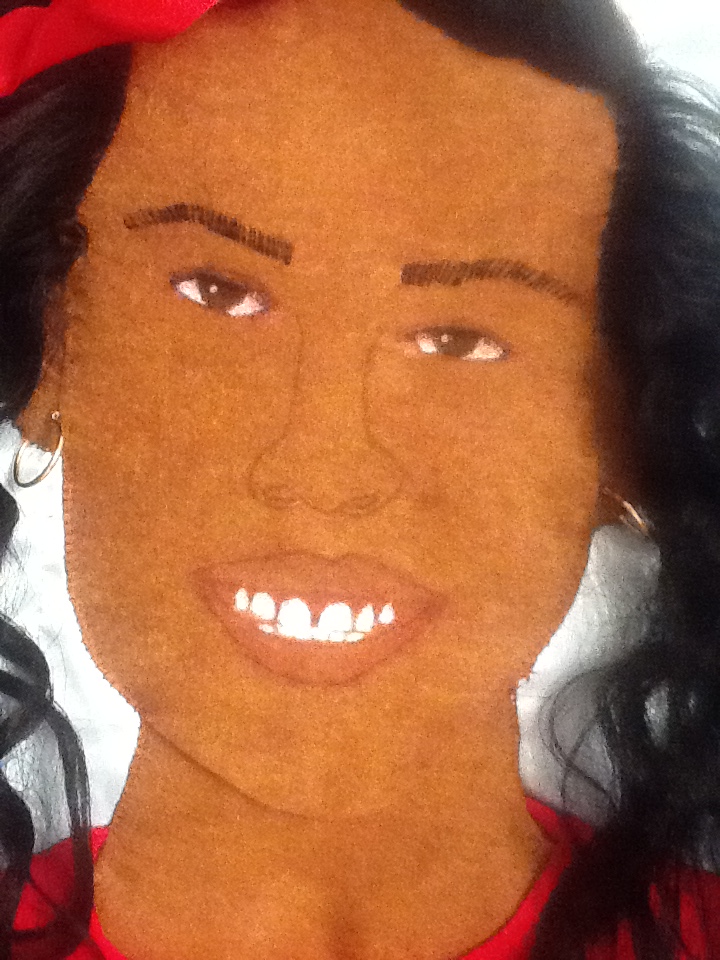

"Riché Deianne Richardson as Jr. Gayfer Girl in 1983 at Age 11 and Dressed for the Group Photo, the First Event after Graduation from Poise-Charm Classes at Gayfers Department Store (formerly Montgomery Fair) in Montgomery Mall"(Family Series, Education Series, Self-Portrait Series)
Mixed-media, including paint, jewelry, fabric, synthetic hair, and denim border and backing

Group Photo of Poise-Charm Class at Eastdale Mall in Montgomery, Alabama, in Spring of 1983, 6th from left on back row

Age 11. Posing for photo after graduation fashion show in spring of 1983 from six-week Poise-Charm Course at Montgomery, Mall; am wearing my favorite piece of clothing at the time (other than my Calvins), my white lace ruffled prairie blouse. We had the matching prairie skirt made by a wonderful seamstress named Edwina who had made a few things for me around that time, like my choir uniform for the Tender Golden Voices at Maggie Street Baptist Church. In the poise-charm course, we learned skills such as runway modeling, introductions, poise-pivot turns, how to sit properly, mannequin modeling, and dealing with different accessories on the runway.

Age 14. Photo shoot at Gayfers Department Store for graduates after completing second poise-charm course, "Seventeen's Beautyworks."
Autobiographical reflections
●All New Junior Gayfer Girl Club members, about 25, wore a red lettered T-Shirt with jeans for the 'Class Photo' Taken in Front of Gayfers at Eastdale Mall; the T-Shirt used on this quilt is a replica and recreation made by T-Shirt Express in Ithaca, NY
●In an era when it seemed that if you didn’t have your Calvins, then you weren’t cool, I was wearing Jordache jeans with a gold Jordache belt because of accidentally burning the label off my Calvins when ironing jeans before class one evening in the spring. Was also wearing a pair of white and blue Jordache canvas tennis shoes whose little yarn horse mane I loved.
●Rhea Alfreds was our instructor, and the overall course program, which included "White Gloves and Party Manners" for small girls and "Seventeen's Beautyworks" (influenced by Seventeen Magazine) for older girls, was coordinated by Wanda Marshall.
●I returned to poise-charm classes at Gayfers for the Seventeen's Beautyworks course at age 14.
●Being a Junior Gayfer Girl for two years (from ages 11-13) came with seasonal 10% store discounts (which were nice to get though I actually used the discount just once). Junior Gayfer Girls also had the opportunity to attend the final rehearsal of the annual "Back to School Fashion Show" of the Gayfer Girls downtown at the Davis Theater. The highlight was being asked to stand up together as a club for recognition briefly as the spotlight panned the audience on the actual night of the show.
● I best remember the show where the theme was "Borrowed from the Boys." Fall fashion items such as ties and tams were modeled to the tune of songs such as "I Wear My Sunglasses at Night" and the theme of Pink Panther films. Attending the show was the highlight of my summer other than attending the University for Youth at Alabama State University, where my family enrolled me four straight summers between ages 12 and 15 for courses taught by university professors.
●This poise-charm class at Montgomery Mall was my only education in a racially integrated educational setting before I was 22 and started my work on a Ph.D. at Duke.
●The other African American girls in this course were my friend LaShaun Hooks who had told me about it in the first place and urged me to take the course with her; her sister Alicia (whom I, like her, called "Lisa"); Candi Turner; Peaches Oldes; and LeCheryl Lesueur.
●I once saw one of our classmates in a clothing store at the newly remodeled Montgomery Mall in high school, who had by then grown tall like I had, and still had the most amazing long, honey-blond curly locks of hair. When recognized by name, she said hello, smiled warmly and said, "We must have met at Cynthia's," a modeling school. She seemed so sure of it that I didn't have the heart to correct her and mention that we were actually in the class together at Gayfers years earlier and that I'd never attended Cynthia's.
●My grandfather, who took me to my classes which met weekly on Thursday evenings for an hour, was okay with me taking the course mainly because it stressed etiquette and cultivated social graces.
●Gayfers purchased Montgomery Fair in Montgomery, Alabama in 1970, which is where Rosa Parks was working at the time of her arrest in 1955.
●A few years later when I was 17, my family bought my debutante dress at Gayfers and had it altered by the store's seamstress, an African American woman named Hannah Foster(who had the job Rosa Parks once had when Gayfers was Montgomery Fair). She also tailored a beautiful wardrobe for me in wool gabardine when I was 25 and in graduate school, and made several lovely matching dresses for my cousins Keri and Megan when they were little girls.
●My Grandmother kept her old Montgomery Fair hat box and also used her and my grandfather's credit card that still said "Montgomery Fair" until Dillard's replaced Gayfers in the late 1990s.
Link below to the review I wrote at Amazon.com of Marjabelle Young Stewart and Ann Buchwald’s book What to Do When and Why: At School, At Home, at Parties, in Your Growing World, which I posted on May 25, 2002. Also see Stewart’s White Gloves and Party Manners, the book that inspired the beginning poise-charm course at Gayfers for little girls.
http://www.amazon.com/What-Do-When-Why-Parties/dp/0883311054/ref=sr_1_10?ie=UTF8&qid=1357628136&sr=8-10&keywords=marjabelle+young+stewart
For Savoir-Faire Everywhere
This book was distributed in the first set of poise-charm classes that I took at Gayfers department store in Montgomery, Alabama at age 11. Through weekly drills, we covered topics such as walking on a runway, making regular poise-pivot turns and Dutch boys, climbing stairs, doing introductions, maintaining good posture, and sitting properly, among others. In the end, we had a fashion show at the mall, and membership in the Jr. Gayfer Girl Club was extended to us, along with seasonal store discounts at 10%. This was the spring of 1983 when "Calvins" still meant almost everything and many girls in my class said that Tom Selleck was their favorite actor[I said mine was Billy Dee Williams, LaShaun said Gary Coleman, and Alicia said Nell Carter]; it was before anyone had ever heard of a concept such as the "supermodel." By this I mean that few if any of us in the class had an idea of who Gia Carangi was or what she represented at the time. As I recall, Stewart's book covers numerous questions: How to set a table? How to make introductions? What to do when you lose your best friend or boyfriend- the kinds of relationships that are at best "iffy" from the start? (And this is where I first learned that word, along with a few others, for overall, Stewart addresses her young audience with the grace of Miss Manners and does not condescend to it by watering down her language). How to handle it when you are the target of gossip? She offers a party lexicon, consisting of varieties such as the "come as you are party." She addresses the importance of sending a "bread and butter" note after visiting someone. There are even, I think, a few recipes. And there's a section for filling in your family tree inside the front cover. We never engaged this book directly in our course, but this was reading that I complemented by poring over illustrated sections on "social graces" in one of the old and very thick dictionaries in our house, which seemed to cover just about everything. I was disappointed that in a later charm course I took at age 14, the official book was one from Seventeen magazine and more focused on makeup instead of the development of social skills along the lines of Stewart's book. I even read and referred to her book many times throughout my early teen years. I finally passed my much-loved copy on to the preteen little sister of my boyfriend when I was 17, for I was tutoring her in math at the time. In retrospect, this is a book that part of me wishes I'd held on to as a keepsake, for only hindsight has allowed me to understand fully the difference that it helped to make in my social, emotional and personal development and maturation. In general, exposure to a text with that kind of orientation at an early age also introduced me to and gave me a deep love and appreciation for the "how to" genre, and to this day, as an adult working as a university professor and moonlighting as an artist, I regularly mix "how to" books into the range of selections that I read. This book may have also put me on the road to cultivating a love for books in the self-help genre, though I don't always have a lot of time to read these kinds of selections. The world has changed a lot since this book's first publication date, and with all the complex issues youth often face in and beyond school settings these days, it may well come across to some as dated and old-fashioned. But I think that there is a timeless quality about it that would make it work for any time.
Tuesday, November 13, 2012
My "I Voted" Facebook Post from November 6, 2012
After voting in Ithaca, New York, I posted the photo below on my page with the accompanying text, "Mission Accomplished!"


Thursday, September 27, 2012
The ‘Bull Dog Mack,’ the Brother in Black, and the Fallacy of Fox News: Reconsidering the Film Convoy


Some of the trends I remember from films during my childhood in the 1970s included movies about epidemics related to animals and insects, movies about possessed children, and movies about cars. Of all of the “car films,” Convoy, which starred Kris Kristofferson as the “Rubber Duck,” is one of my all-time favorites from that period. The black Mack gas truck of the “Rubber Duck,” with its headlights that resemble eyes, seems to be personified on some levels. In my favorite version of the theme song entitled "Convoy" by C.W. McCall, it is referred to as a "Bulldog Mack with a can on back and a Jaguar hauling ass." Driving this iconic truck through the states of Arizona, New Mexico and Texas in the West, the “Rubber Duck,” a quintessential alpha male figure, courageously leads a diverse and eclectic convoy of truckers, until his fateful standoff with the diabolic sheriff “Dirty Lyle.” The most provocative scene occurs when the Rubber Duck, upon hearing that "Spider Mike"- a black trucker in the convoy-has been beaten brutally and jailed, literally drives this big rig through the walls of the jail to rescue him. The shocking scene sets the stage for the penultimate standoff with the sheriff, who sets up a blockade on the U.S.-Mexico border that includes the National Guard with the goal of capturing and ambushing the Rubber Duck.
We first see the Rubber Duck’s love interest, a woman named Melissa portrayed by the actress Ali McGraw, driving on the road behind him in a black Jaguar and snapping photographs of him as the film begins in Arizona. As the Rubber Duck nears the roadblock and senses the danger, he tells her, in order to save and protect her, to “get out” of the truck, and throws out her bag. With determination, he drives on to meet the blockade as she makes a dramatic run down the road after his truck. He drives straight into the fire of the machine guns that target the truck as he nears the bridge, and that ultimately focus on the gas tanks to ensure his annihilation. Seeing the Rubber Duck’s truck ambushed in this film was as heartbreaking to me as a child as the death of the dog Old Yeller. Yet, he is redeemed when we learn that he survived after all (i.e. “Have you ever seen a duck that couldn’t swim"). I do not think that one of my favorite television series by the end of the seventies, B.J. and the Bear (the Bear was a little monkey), would have been as conceivable without this film.
Looking back at Convoy from my adult standpoint, I have appreciated its powerful message all the more, including its critique of state-sanctioned violence and visionary examination of white male working class subjectivity. I’ve realized the genius of the Rubber Duck in finishing the drive to the bridge from the floor of his truck cab amidst the heavy gunfire, and in ensuring that the gas tank is disconnected from his truck just as he reaches the middle of it, so that he can drive off and survive the explosion. This film is truly revolutionary, and I don’t say that now just because I am a longtime fan. As a character, the Rubber Duck’s commitment to social justice, and resistance to abusive law enforcement and police brutality as embodied in “Dirty Lyle,” lies in the continuum with Black Panther Party philosophy, making its release in the immediate years after the black power/Civil Rights Movement all the more significant. Dirty Lyle, even in his naming, fits the definition of the "pigs" invoked in the theme song for this film, which interestingly and provocatively recasts aspects of Black liberation movement rhetoric designed to critique abusive forms of law enforcement. This film also has important implications for discourses on immigration given that it is set in the U.S. Southwest and highlights this confrontation with state authority on the border between the U.S. and Mexico. I appreciate this film for envisioning possibilities for solidarity across racial lines between white working class men, African Americans and other people of color. The Rubber Duck’s heroic if extreme choice to crash his truck through a small-town jail to rescue Spider Mike, who has been horribly beaten by the police and needs urgent medical attention, even speaks volumes about black men and forms of abuse and violence that some have experienced, along with compulsive imprisonment within the corporatized prison industrial complex that has only escalated in the years since this film first appeared. I think it is very significant that characters such as the “Black Widow” and “Spider Mike” make up the Rubber Duck’s diverse convoy, and that the Rubber Duck risks and sacrifices his own life to rescue a black man such as “Spider Mike” from jail. For crashing the rig through the jail impacts all of the action that follows in the film. In this film, the Rubber Duck emerges as a model of an antiracist white man and serves as his brother’s keeper.
Similarly, I would say that the Smokey and the Bandit sequence of “car films” starring Burt Reynolds and Jackie Gleason has a distinct populist impulse and also radically dramatizes the confrontation of working class white men with forms of bullying by police authority and vigilante violence that have been very familiar in some black communities. The film uses comedy to make some of the critiques of this hegemonic system that films such as In the Heat of the Night made more dramatically at the outset of the post-civil rights era. The “Bandit,” like the “Rubber Duck,” emerges as a quintessential white masculine “outlaw” figure who resists and evades forms of brutal state authority and surveillance. It is also noteworthy that in the former, Sheriff Buford T. Justice goes so far as to threaten to "barbecue" (and therefore lynch) an Asian truck driver who went through a road blockade and knocked off his car door, and to hang the Bandit from the highest tree, moments that register the history of such practices on the Southern landscape. I want to underscore that Convoy is an important and even indispensable film to think about in pondering representations of the black liberation movement in popular culture during the 1970s.
I was deeply honored and inspired to see Kris Kristofferson speak at the march on the Martin Luther King holiday in downtown Atlanta as a college student in the Atlanta University Center in 1992; I valued seeing the hero of one of my favorite childhood films in person, and speaking about such important social issues, which sounded like what the Rubber Duck would do. I realize and respect that his politics have evolved in some ways over the years. That is beside the point, and really, to be expected. One thing that I find utterly mystifying, however, is the ease with which Fox News appropriated the powerful theme song of this film several years ago to describe the goal of taking their message, including the Tea Party discourse, “across the U.S.A.” It is a move that recalls the Right-Wing appropriation of Bruce Springsteen’s song “Born in the U.S.A.” in 1984, which the scholar James Kavanaugh examines in an essay on “Ideology”: “At stake here was how the vast appeal of an attractive cultural icon, and the wildly popular and pleasing cultural texts (rock songs) he produced, could be appropriated to support specific political and socioeconomic programs.”
The 1975 song “Convoy” by McCall has definitely had a range of interesting remakes, but this appropriation by Fox News seemed so inappropriate, and even ridiculous, given the thematic content of the film centered on protecting the rights of working class and grassroots communities and its deep investment in interrogating forms of state authority, as opposed to reconsolidating and reinforcing it within a discourse that is at the same time, staunchly anti-government. When I first heard it sampled on the network, I remember thinking, “When was the last time Glenn Beck drove a big rig through a jail house to rescue a black man from police brutality?” I value the message of this film especially when thinking of longstanding forms of class warfare that have relied on racism to divide poor whites from the black masses since the antebellum era, along with contemporary ideologies that have worked to align white working class voters with the white elite and that have routinely appropriated populist agendas. Whatever its merits may be, there are critiques aplenty of Fox News and my goal is certainly not to make yet another one here; while I do not support some of its journalistic practices, I believe in freedom of the press, and Fox News is part of that, for better and for worse.
Rather, my concern is with the readiness with which the message of this one film got turned around by Fox, which provides a sobering reminder of how easily these mind-bending ideological reversals and appropriations can happen within the public sphere of politics, along with the shortness of cultural memory in some cases.
The original message of the film Convoy does not ever need to be lost. Thank goodness the film’s real story says otherwise and dramatizes the great things that can happen when we remember the ties that unite us, rather than the lines that divide us, and indeed, dare to become our brother and sister’s keeper. For all of these reasons, and after all of these years, the Rubber Duck is and remains a true hero in my estimation.
*The full length version of the film Convoy, videos of the ending and of the theme song are all available on YouTube
Thursday, August 30, 2012
Black Global Girls Rock from Phillis Wheatley to Gabby Douglas!


Daughter of Africa, Mother of African American Literature, Another American Revolution (Black History Series, African American Literature Series, & New Daughters of Africa Series). Dedicated to Honorée Jeffers.

Olympic gymanist and Gold Medalist Gabrielle Douglas
Even as a woman who stands 6’2” and has never taken gymnastics or had an interest in playing sports at all, I have long been a fan of women’s gymnastics and look forward to this event at every Olympics. My 2003 Mississippi Quarterly essay entitled “ Southern Turns” begins with a discussion of what I felt was at stake in the images of antebellum Southern romance that animated the opening ceremony of the Atlanta Olympic Games in 1996, from strutting belles to strutting gentlemen, along with the running commentary during the opening parade on nations that had “never won a medal.” As I began my dissertation at Duke that summer, I followed those games with great interest, including the gymnastics competitions. I was especially interested in African American gymnast Dominique Dawes. I was happy when the U.S. won the team Gold, though concerned about the pressure on Kerri Strugg to stick her second vault on a sprained ankle. Even before the games started, it had been frustrating to hear Shannon Miller and Dominique Moceanu described as the U.S. team members most likely to win gold during the Individual All Around. Yet, the reality that most people have forgotten is that Dawes advanced further than either one of them in this competition. I noticed how alone Dawes was every time that she went out on the floor and did her routines and then returned to her teammates on the sidelines, who seemed to ignore her and failed time after time to affirm her or embrace her after these impressive performances. Yet, they embraced one another. I respected Dawes all the more for the strength, focus and tenacity that she demonstrated in spite of it all. When she stepped out of bounds during the floor routine in the Individual All Around, I was devastated and mortified. I literally cried myself to sleep that night because seeing her dream lost was heartbreaking. Talk show host Rosie O’Donnell and many others were crying right along with me because so many people knew and cared about how much was at stake for all of the talented girls competing.
Just as I was happy to see Dawes make history on the team she helped to victory in 1996, I have been heartened and inspired that once again, a black teen gymnast has been instrumental in helping the U.S. gymnastics team win its second gold medal, and went on to become the first black girl and woman to ever win the Individual All Around in women’s gymnastics. One of my undergraduate mentors at Spelman College, Christine Wick Sizemore, published an academic study in 1989 entitled A Female Vision of the City: London in the Novels of Five British Women. I am intrigued by the parallel ways in which London served as the geographical context for the emergence of Phillis Wheatley as a writer of international renown given that it was the site where her first book was published and a place she visited. Similarly, I am intrigued by how the city of London, as the site of the 2012 Olympic Games, has launched Gabby as an international celebrity in recent weeks. Indeed, Skip Gates’s short book The Trials of Phillis Wheatley: America’s First Black Poet and Her Encounters with the Founding Fathers, which I have also assigned several times in my African American literature survey, compellingly describes Wheatley as an international celebrity and the “Toni Morrison of her time,” the late eighteenth century. Even beyond these general similarities, I would say that both teens, in spite of their separation by several centuries, have been primarily grounded by their Christian faith. Both teens, for different reasons, and in spite of their clear talents and abilities, were subjected to forms of intense public scrutiny and "tests" of sorts in which they had to “prove themselves.” Stories about Wheatley often highlight the “Attestation” that she famously endured in Boston, in which she was questioned by a panel of distinguished gentlemen to ascertain her authorship of the poems in her volume. Perhaps the most famous and significant signature among the fourteen signatures is that of John Hancock, who later signed the Declaration of Independence, and whose name itself has become the quintessential signifier and noun referencing the signature in our nation’s vernacular. Similarly, Gabby Douglas performed for an international audience under intense scrutiny during the London Olympic Games before a panel of international judges. She seemed to be judged as much in the news media about the question of her readiness and potential to be a champion as a gymnast. In the end, it is much to her credit that she not only proved herself but also proved her critics wrong. It is also intriguing that just as Wheatley, notwithstanding her slave status, received support and tutelage within the household of her white owners-John and Susannah Wheatley-that helped her to gain literacy and come to voice as a poet, Gabby Douglas’s success was enabled not only by the support and sacrifices of her mother Natalie Hawkins, but also by her white host family in Iowa, which included Travis and Missy Parton and their four daughters. Such stories, then as now, not only have important implications related to how and why forms of white patronage have been recurrently instrumental in determining black mobility and success in the U.S., but also have implications for the discourses on transracial adoption and mixed-race identity. Just as the young Wheatley engaged distinguished public figures, from Benjamin Franklin to George Washington, Gabby Douglas has had encounters with figures from First Lady Michelle Obama to Oprah Winfrey, whose embraces and affirmations underscore the significance of Douglas’s historic achievement for little black girls and teens everywhere, as well as for black women, all Americans and fans around the world. While Wheatley wrote and gained her freedom in the face of an Enlightenment sensibility that devalued the black body and mind and viewed blacks as inferior, Douglas has made her mark as an athlete in a millennial culture that has been prematurely described as postracial, and in which the ideological devaluation of the black body persists.
I was inspired to see the interview with Douglas and her mother this past weekend on Oprah Winfrey Presents, as well as her coach Liang Chow, and her host family, the Partons. In this interview, it was particularly sobering to hear about the “bullying” that Douglas endured as a young teen at her former gym in Virginia Beach, to the point of being isolated by other girls and referred to as a “slave," experiences that shaped her choice to leave. It is just as appalling to hear denials of these incidents, including those of her former coach, which suggest that Gabby is somehow lying. For example, Gustavo Maure of Excalibur Gymnastics has stated to E! News that “Gabby’s remarks were hurtful and without merit . . . Her African American former teammates will answer this serious accusation . . . We are good people. We never were knowingly involved in any type of bullying or racist treatment, like she is accusing Excalibur.” Another gymnast said that the comments were “absolutely ridiculous.” Another spokesperson said that “Gabby was never a victim, in fact many would say she was one of the favorites. . . I am not saying that she never felt bullied because when you are in a sport with a bunch of girls it is bond[sic] to happen. However, anything that she may have felt was never about race and I can assure you everyone at some point has felt bullied.”
I find these efforts to dispute, dismiss and discount Douglas’s experiences to be deeply problematic. All that the refutations of Douglas’s story demonstrate to me is that if you are not black or invested in anti-racism, then what counts as racism may not be visible, detectable, or even important to you. Yet, such racial incidents are magnified 50,000 times and are extremely noticeable and hurtful to anybody who actually experiences them, and can do the kind of harm that you don’t, or worse, WON’T, see. The refutations and denials also demonstrate the persisting uses and abuses of the discourses of colorblindness to discredit black experiences of racism. We always have to be vigilant in not re inscribing stereotypes of the U.S. South as a racist region, but the behavior sounds like the kind that could very well happen in a Southern gym. Some girls and women in gymnastics can see the sport as a club that belongs to them and one in which black girls like Gabby have no right or place. Furthermore, in the interview, it is important to acknowledge that both Gabby Douglas and her mother, Mrs. Hawkins, demonstrated a reluctance to claim that all of the problems the former experienced were related to race; Oprah Winfrey also made the distinctions clear. It is not as if Gabby Douglas is crying wolf here, so to speak. These experiences sound very real, and are far too commonplace for her to have ever made up.
I believe her, too, because as she was describing what happened to her at her gym in her interview, I was reminded of things that have also happened to me in academia. For example, her reflections on her experiences at her gym reminded me of how two white women on the faculty on my former job would actually walk into the room for faculty meeting, see me sitting alone at the table there and waiting for it to begin, yet not speak or acknowledge my presence, and just sit down and start talking to each other. It happened several times. It was as if they were trying to hurt my feelings or trying to remind me that they had some kind of “club” of which I was not a part-as if I would have even wanted to be a part of it! One of them even came into the mail room when I was already there several times and walked in and out without speaking. Those behaviors, which some black women in the academy are equally capable of manifesting, were all the more mystifying when considering that there were absolutely no contexts to explain why on earth they were behaving like that. I was the wrong person to try that with, for from my earliest childhood, I was taught by people like my grandmother to stay away from any children who acted funny or as if they didn’t want to play with me. On top of this, I grew up hearing strong condemnations in our household of the types of people who “lick and lap up behind folks” and “buy friendship,” so have NEVER, EVER done those things in my life, nor have I ever cared when someone did not like me. Moreover, a lifetime of hearing one-line sayings like “one monkey don’t stop the show” has also kept me grounded and constantly reminded of who is important to me in the larger scheme of things-and who isn’t. Even in places where racism is not so much institutionally sanctioned and where one’s presence, on top of one’s work and credentials, helps to diversify a place in ways that most other people appreciate, racism can come out in interpersonal interactions in some cases. Minority scholars are often its targets.
Similarly, I was appalled when a topmost administrator (I won’t get any more specific and will just leave it at that) walked up to a group of three white professors in which I was also standing and talking about the subject of home-schooling at a major university conference/retreat in 2006. He spoke to and acknowledged each one of them and shook their hands, but ignored me standing there. That moment, especially as someone who had just gotten tenure the year before, was sobering for me and a real eye-opener. I remember thinking that “If they want to play this dirty game with me, I’m going to show them how to play it!” I remember thinking with the deepest indignation in the ensuing weeks that “I am the one who was a debutante! I am the one who flies first class! I am the one who is in a sorority!” and so forth and so on. Similarly, in the spring of 2008, when I was among the honorees at a gathering, and he happened to be sitting at my table, he asked, “What office do you work in on campus?” instead of presuming that I was a professor on campus. I could not help but think that in his mind, any black woman seemed to register automatically as staff. (That moment was roughly analogous to once going downstairs in my high rise condominium building to pick up a package-the only apartment building in downtown Sacramento with a doorman-and being asked by a new woman in the management office, “Who are you picking up mail for?” as if I as a black woman must be working as a domestic for somebody in the building, instead of actually living there). People like him and experiences like that really compelled me to tighten my filters and narrow my circle as an academic. All of these dynamics, along with the ones that Gabby Douglas describes in her landmark interview with Oprah Winfrey, also remind me of a passage I read in a chapter entitled “The Staying Power of Racism” in Alabama writer and scholar Trudier Harris’s memoir, Summer Snow: Reflections from a Black Daughter of the South: “I remember how shocked I was when a white male colleague and I were both in our offices early one morning, long before others had arrived, and we happened to enter the hallway at the same time. ‘Good morning,’ I called out. He said nothing. Whatever excuses I might have tried to attribute to his behavior proved over the years to be irrelevant, for he had conveyed precisely what he wanted to convey-that he elected not to acknowledge my existence in those private moments. The same was true of another white man. Yet, when these English departments held receptions and public gatherings, both men would join in groups in which I was involved in conversations and pretend that we had been best buddies for years. Both these men valued the opinions of their nonblack colleagues so they toed the proper racial line among them. Yet their hearts remained unchanged.”
I’ve said all of this to say that I believe Gabby Douglas in part because the experiences that she claims to have had at her Virginia gym DO happen to black people and other people of color all the time, and also even happen to some whites on the basis of factors such as race, class, gender, nationality, and sexuality. I believe her because I have experienced similar things myself in instances, along with many people I know. I believe her because of what I even saw Dominque Dawes experience. And because I just believe her.
I want to suggest that the profound continuities in the stories of Gabby Douglas and Phillis Wheatley are useful to recognize and think about in African American literary and cultural history. That in the wake of her Olympic triumph, Gabby has adopted a “new name,” or rather, reclaimed her given name of “Gabrielle,” also compels me to think about how her story adapts, revises and expands recurrent narratives and motifs in African American literary history, beginning with devices established in the slave narrative as a genre, and how her story relates to that of a figure in African American literary history such as Phillis Wheatley. Gabby Douglas, like Phillis Wheatley, has become a global phenomenon, is also incredibly talented and gifted, and has a story that can even help us to introduce Wheatley to new generations of young girls and students. For all of the reasons that I have outlined in this post, I suggest that the story of Gabrielle Douglas is useful to “think with,” “teach with” and write through as a scholar in areas such as American and African American literature, Southern studies, gender studies, cultural studies, popular culture, and Africana studies.
Subscribe to:
Posts (Atom)

 Posts
Posts


